
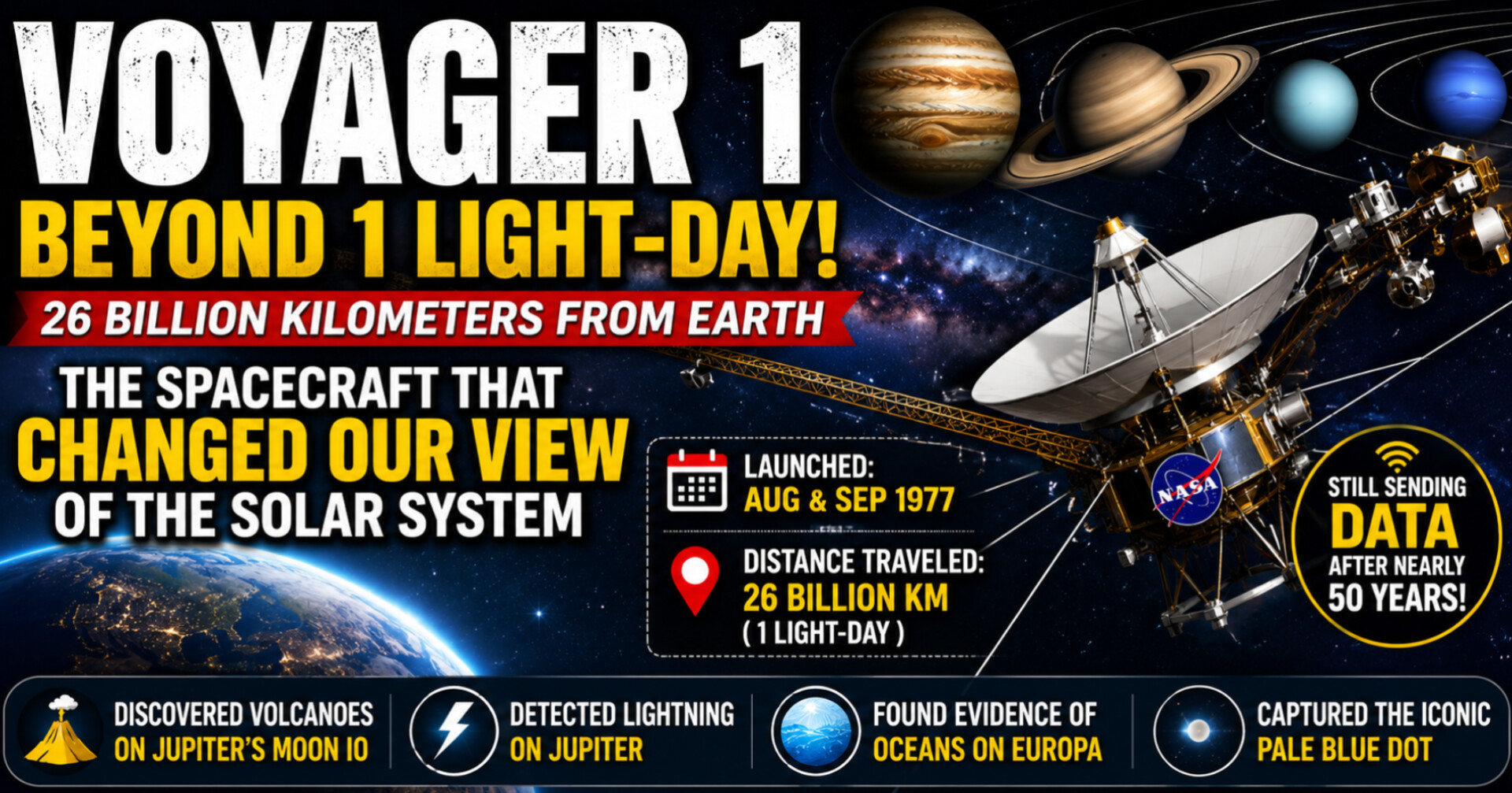
Few human achievements have transformed our understanding of the universe as profoundly as NASA’s Voyager mission. Launched in 1977, Voyager 1 continues to travel farther into space than any other human-made object, while still sending valuable scientific data back to Earth nearly five decades later.
This November, Voyager 1 is expected to pass a remarkable milestone by traveling beyond one light-day from Earth. A light-day represents the distance that light travels in a single day, approximately 26 billion kilometers. No other human-made object has ever ventured so far from our planet.
A Mission That Exceeded Every Expectation
Voyager 1 and its twin spacecraft, Voyager 2, were originally designed to operate for about five years. However, both spacecraft remain active after nearly 50 years in space.
What makes this achievement even more remarkable is the technology used to build them. According to Voyager project scientist Dr. Linda Spilker, the spacecraft’s onboard computer contains less memory than many modern electronic devices, including some remote-control systems.
Despite these limitations, the Voyager spacecraft continue to provide scientists with invaluable information about our solar system and the space beyond it.
The Grand Tour of the Outer Planets
The Voyager mission was developed during a rare planetary alignment involving Jupiter, Saturn, Uranus, and Neptune. This alignment created a once-in-a-lifetime opportunity for a spacecraft to visit multiple planets using their gravitational pull to gain speed and change direction.
Scientists referred to this unique opportunity as the “Grand Tour.”
Voyager 2 was launched in August 1977, followed by Voyager 1 in September. Although launched later, Voyager 1 eventually overtook its twin spacecraft due to its faster trajectory.
Discoveries That Changed Astronomy
The Voyager mission delivered discoveries that reshaped scientific understanding of the outer planets.
Voyager 1 identified active volcanoes on Io, one of Jupiter’s moons, marking the first discovery of active volcanism beyond Earth. It also detected lightning on Jupiter, providing evidence of complex atmospheric activity.
Meanwhile, images captured by Voyager 2 suggested that Jupiter’s moon Europa could contain a vast liquid ocean beneath its icy surface. This finding continues to fuel scientific interest in the possibility of extraterrestrial life.
These discoveries transformed the way scientists viewed the solar system and opened new avenues for future exploration.
The Famous Pale Blue Dot
Before Voyager’s camera system was shut down in 1990 to conserve power, it turned back toward Earth and captured one of the most iconic images in history.
The photograph showed Earth as a tiny pale blue dot suspended in the vastness of space. Inspired by astronomer Carl Sagan, the image became a powerful reminder of humanity’s place in the universe and the importance of protecting our planet.
Entering Interstellar Space
In 2012, Voyager 1 became the first human-made object to enter interstellar space after crossing the boundary of the Sun’s influence. Voyager 2 followed in 2018.
Even today, both spacecraft continue transmitting data from a region of space that had never been directly explored before. Scientists believe at least one scientific instrument on each spacecraft could continue operating into the 2030s.
A Legacy That Will Outlive Humanity
Each Voyager spacecraft carries a gold-plated record containing greetings in 55 languages, 115 photographs, and a collection of sounds and music from Earth.
These records were designed as a message to any intelligent life that may one day encounter the spacecraft. Long after the spacecraft stop transmitting, these golden records could survive for billions of years, carrying a lasting record of humanity’s existence.
The Voyager mission remains one of humanity’s greatest scientific achievements, demonstrating how curiosity, innovation, and exploration can expand our understanding of the cosmos.