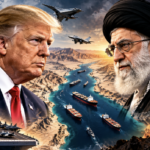
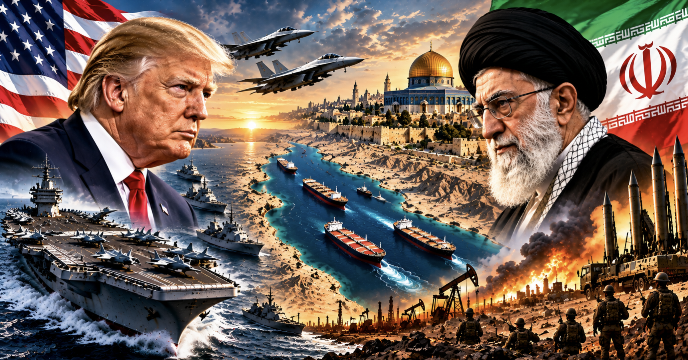
The Middle East is once again facing a major security crisis, with Iran at the centre of growing tensions involving the United States, Israel and several regional powers.
The latest developments have raised concerns about military escalation, the Strait of Hormuz, global energy supplies and the possibility that a conflict involving Iran could affect countries far beyond the Middle East.
As of October 2, 2026, the situation remains fluid. The United States is increasing its military presence in the region, an unidentified projectile has struck a tanker in the Strait of Hormuz, and diplomatic efforts between Washington and Tehran remain uncertain.
To understand why the current crisis matters, however, it is necessary to look at the history behind the relationship between Iran, the United States and the wider Middle East.
The Middle East: A Region Shaped by Power and Competition
The modern Middle East has been shaped by the collapse of empires, the creation of new borders, competition over natural resources and the involvement of major global powers.
The collapse of the Ottoman Empire after World War I contributed to the formation of many of the political boundaries that define the region today.
During the Cold War, the United States and the Soviet Union competed for influence across the Middle East. Oil, military alliances, Israel’s security and regional stability became major components of international strategy.
Iran developed into one of the most important states in this wider competition.
Iran Before the 1979 Revolution
For much of the 20th century, Iran and the United States were partners.
Iran was ruled by Shah Mohammad Reza Pahlavi, whose government maintained close political, military and economic relations with Washington.
But the relationship had an earlier and complicated history.
In 1953, U.S. and British intelligence helped overthrow Iranian Prime Minister Mohammad Mossadeq after tensions surrounding Iran’s nationalisation of the Anglo-Iranian Oil Company. The Shah’s position was subsequently strengthened.
The 1953 episode remains an important part of how many Iranians understand the country’s relationship with the United States.
The 1979 Iranian Revolution Changed Everything
The biggest turning point came in 1979.
Mass protests forced the Shah to leave Iran, and Ayatollah Ruhollah Khomeini returned from exile and became the dominant political and religious leader of the new Islamic Republic.
Iran moved from being a close U.S. partner to becoming one of Washington’s strongest regional opponents.
Later that year, Iranian students seized the U.S. Embassy in Tehran and held American diplomats hostage for 444 days.
The United States severed diplomatic relations with Iran and imposed sanctions.
That breakdown in relations continues to influence the two countries more than four decades later.
The Iran-Iraq War Added Another Layer
In 1980, Iraq under Saddam Hussein invaded Iran.
The war lasted eight years and became one of the region’s most devastating conflicts of the 20th century.
The conflict also demonstrated how quickly a regional war could affect international interests.
The security of oil supplies and shipping routes became increasingly important, while the United States and other powers became involved in different ways.
The so-called Tanker War of the late 1980s demonstrated the strategic importance of Gulf shipping routes long before today’s crisis.
Why Iran Is So Important Today
Iran’s geographical position gives it enormous strategic importance.
It sits between Central Asia, the Persian Gulf and the wider Middle East.
Most importantly, Iran is located alongside the Strait of Hormuz.
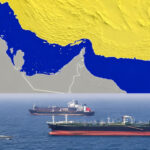
The narrow waterway connects the Persian Gulf with the Gulf of Oman and the Arabian Sea.
For decades, it has been one of the world’s most important energy chokepoints.
That is why tensions involving Iran can quickly become a global economic-security issue.
The Strait of Hormuz Is at the Centre of the Current Crisis
The latest conflict has placed the Strait of Hormuz directly at the centre of the confrontation.
Recent data indicate that crude-oil exports through the region recovered substantially during September, even though shipping remained subject to serious security risks.
At the same time, refined-product shipments have remained far below pre-war levels.
Reuters reported that around 16.5 million barrels per day of crude left the region in September, roughly matching the pre-war level, while refined-product flows remained severely disrupted.
That difference is important.
Oil production may continue, but transporting energy safely is another matter.
Tanker Incident Raises Fresh Concerns
On October 2, the UK Maritime Trade Operations agency reported that a large tanker carrying up to 2.5 million barrels had been hit by an unidentified projectile while travelling through the Strait of Hormuz.
The incident caused a fire, according to reports.
The identity of those responsible was not immediately established.
This illustrates the continuing risk for commercial shipping even when some energy flows have recovered.
The United States Is Increasing Its Military Presence
Another major development is the reported expansion of the U.S. military presence around Iran.
Al Jazeera reported that the USS Theodore Roosevelt strike group and the Makin Island amphibious force, carrying around 2,000 Marines, were moving toward the Middle East. The report said three carrier groups and two landing groups could ultimately be positioned around Iran.
The deployment does not by itself establish that another major attack will occur.
But it increases the military options available to Washington at a time when diplomatic relations with Tehran remain extremely fragile.
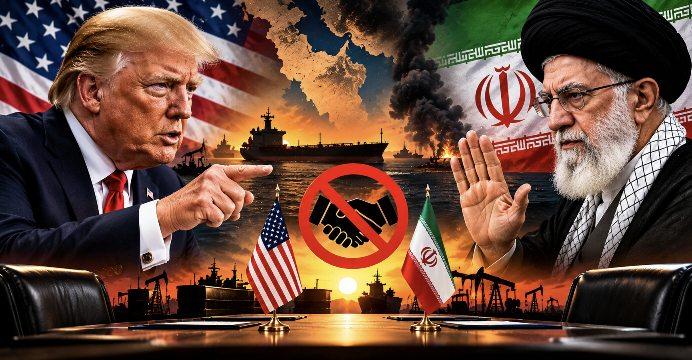
Trump Rejects Iran’s Latest Proposal
U.S. President Donald Trump has rejected Iran’s latest proposal concerning the Strait of Hormuz, describing it as insufficient.
At the same time, Iranian President Masoud Pezeshkian has said that Iran has not avoided dialogue.
This creates an unusual situation in which military preparations and diplomatic signals are occurring simultaneously.
The central question is whether negotiations can prevent another major escalation.
Why Diplomacy Has Struggled
Washington and Tehran have fundamentally different positions on several issues.
Among the most important are:
- Iran’s nuclear programme
- Sanctions
- The Strait of Hormuz
- Regional armed groups
- U.S. military forces in the region
- Israel’s security
- Iran’s regional influence
Previous negotiations and ceasefire arrangements have failed to produce a durable settlement.
The Council on Foreign Relations says unresolved disputes over Iran’s nuclear programme, the Strait of Hormuz and sanctions relief remain central to the conflict.
Israel’s Role in the Security Equation
Iran’s relationship with Israel is another major part of the regional security picture.
Iran and Israel have been strategic adversaries for decades, and their confrontation has increasingly moved beyond indirect competition.
Any major U.S.-Iran escalation therefore has implications for Israel and other countries in the region.
A wider conflict could involve missile attacks, drones, cyber operations, military bases, shipping routes and regional armed groups.
That is one reason governments across the region are closely watching developments between Washington and Tehran.
The Conflict Is No Longer Only About Iran
One of the biggest lessons from the current crisis is that a conflict involving Iran can quickly become an international issue.
The consequences can spread through:
Energy → Shipping → Insurance → Inflation → Trade → Military deployments → Global markets
The Strait of Hormuz is particularly important because disruptions there can affect energy-importing economies across Asia and Europe.
Reuters reported that LNG shipments through Hormuz increased in September, but shipping companies continue to face security concerns and higher operational costs.
What About Saudi Arabia and Other Gulf States?
Saudi Arabia, the United Arab Emirates, Qatar, Kuwait, Bahrain and Oman all have important interests in the stability of the Gulf.
A prolonged conflict creates difficult choices for these countries.
They need to protect their territory and economic infrastructure while avoiding being pulled directly into a wider war.
Recent reports have also described missile and drone threats involving Yemen’s Houthi movement and Saudi Arabia, showing how regional tensions can spread beyond the immediate U.S.-Iran confrontation.
The Historical Pattern Is Important
The current crisis did not emerge overnight.
It is the product of decades of:
- U.S.-Iran hostility
- Iranian regional ambitions
- Israel-Iran rivalry
- Gulf security competition
- Nuclear disputes
- Sanctions
- Proxy conflicts
- Competition over strategic waterways
The 1953 coup, the 1979 revolution, the hostage crisis, the Iran-Iraq War and later nuclear negotiations all form parts of the larger historical picture.
Understanding that history makes today’s developments easier to follow.
What Happens Next?
Several possibilities remain open.
Diplomatic negotiations could produce another temporary arrangement.
Military tensions could remain at their current level.
Alternatively, a new attack or incident involving shipping could trigger another round of escalation.
The Strait of Hormuz will remain one of the most important indicators to watch.
So will the movement of U.S. military forces, Iranian statements, Israeli actions, regional missile and drone activity, and international diplomatic efforts.
Conclusion
The Middle East’s current crisis cannot be understood simply as another confrontation between Iran and the United States.
It is the latest chapter in a much longer history involving Iran’s relationship with the West, Israel’s security concerns, Gulf power competition, energy routes and the strategic interests of major global powers.
The latest developments are particularly significant because military forces are increasing around the region while diplomatic efforts remain uncertain.
The reported tanker incident in the Strait of Hormuz demonstrates that even when some oil and gas shipments recover, the security risk has not disappeared.
For the rest of the world, the biggest concern is whether the current confrontation remains contained or develops into a wider regional crisis.
The answer could have consequences not only for the Middle East, but also for global energy markets, international shipping, trade and security.